How to Name an AI Startup
Learn how to name an AI startup with a framework that balances capability, trust, category clarity, and long-term brand defensibility.
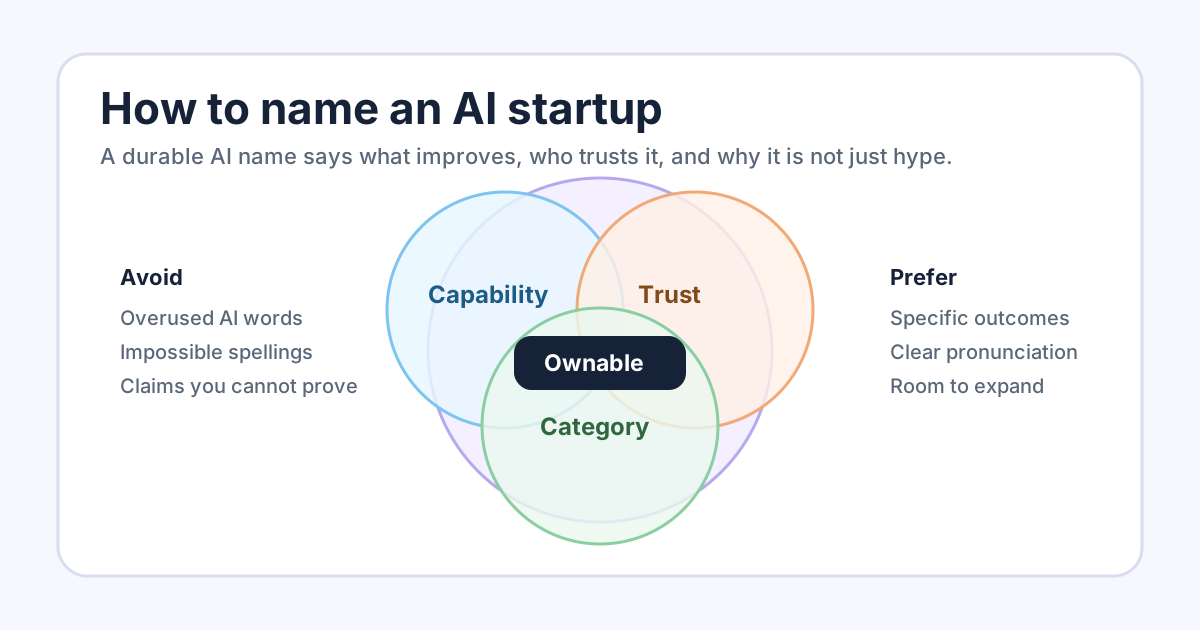 A durable AI startup name balances capability, trust, category, and ownership.
AI startup names have a specific problem: the market moves fast, and trendy language ages quickly. A name that sounds exciting today can feel generic once every competitor uses the same words.
The best AI names do more than say "AI." They tell buyers what gets better, why the product can be trusted, and where the company can grow.
Avoid Starting With Hype Words
Words like "copilot," "agent," "neural," "gen," "bot," and "intelligence" can be useful in the right context, but they are crowded. If your entire name depends on the current AI vocabulary, it may be harder to stand out and harder to defend.
Before using an obvious AI word, ask:
- Does it clarify the product or just signal trendiness?
- Will it still make sense in three years?
- Are many competitors using the same word?
- Can we trademark or own the phrase?
- Does it make a claim we can support?
AI buyers are getting more sophisticated. They want outcomes, not just buzzwords.
Name the Outcome, Not the Model
Most customers do not buy a model architecture. They buy saved time, better decisions, fewer errors, faster research, cleaner workflows, or new revenue.
Start with the outcome:
- Faster support resolution
- Better financial forecasting
- Safer code review
- Easier document analysis
- More accurate lead routing
- Lower manual operations work
Then brainstorm names that suggest that outcome. This can lead to words around clarity, signal, flow, review, guardrails, navigation, memory, or acceleration.
Build Trust Into the Name
AI products often handle sensitive workflows. A name that sounds too playful may be wrong for legal, finance, healthcare, security, or enterprise operations.
Trust does not require a boring name, but it does require fit. For high-stakes markets, names should sound stable, precise, and credible. For creative AI products, names can be more expressive.
Test the name against your buyer:
- Would a CTO trust this in production?
- Would a CFO approve it in a budget meeting?
- Would a lawyer find it unserious?
- Would a creator remember it after one demo?
The answer depends on the market. A name that works for a design tool may fail for a compliance platform.
Decide Whether .ai Helps or Hurts
.ai can be a strong extension when AI is central to the product. It signals category fit and often gives founders access to shorter domains than .com.
Use .ai when:
- AI is the core product, not a side feature.
- Your buyer expects AI-native tooling.
- The full domain is short and clean.
- The name still works if spoken aloud.
Be cautious when the company may expand beyond AI or when the audience is not technical. In those cases, a .com or clean modifier domain may feel more durable.
For a deeper comparison, read .com vs .ai vs .io.
Watch for Category Confusion
AI names can become too abstract. A name that sounds like a research lab, chatbot, design tool, and analytics product all at once may not help buyers understand you.
Add category clarity through one of these methods:
- A slightly more descriptive name
- A clear tagline
- A category-focused homepage title
- A domain modifier that makes the use case obvious
- Content that explains the workflow
The name does not need to do everything, but it should not fight the positioning.
Generate Name Territories
Instead of brainstorming one list, create several territories:
- Trust and safety: guard, proof, audit, vault, verify
- Speed and automation: flow, sprint, route, instant, autopilot
- Knowledge and research: signal, atlas, index, lens, recall
- Creation and design: spark, canvas, forge, studio, motif
- Operations and workflow: queue, stack, sync, run, grid
Then generate names inside each territory. DomainRapids can help you explore these directions quickly and compare which ones have viable domains.
Validate Before You Commit
For each finalist, check:
- Domain availability
- Trademark conflicts
- Similar AI companies
- GitHub and developer ecosystem conflicts
- App store and marketplace conflicts
- Social handle consistency
- Pronunciation and spelling
AI categories are crowded, so similar names are common. Do not rely on domain availability alone.
Frequently Asked Questions
Should my AI startup include AI in the name?
Only if it improves clarity. Many strong AI companies use names that imply intelligence or outcomes without literally saying AI.
Is .ai better than .com for an AI startup?
Not always. .ai can be excellent for category signal, while .com is broader and more universally trusted. Choose the cleaner full domain for your audience.
Are invented names good for AI companies?
They can be strong if they are easy to say and support the positioning. Avoid invented names that look random or require constant spelling help.
How do I avoid sounding like every other AI tool?
Start from the customer outcome and market trust requirement, not from common AI buzzwords.
Next Step
After you choose a finalist, use the Domain Name Checklist Before Launch to catch operational issues before announcing.