.com vs .ai vs .io: Which Domain Extension Should Startups Choose?
Compare .com, .ai, and .io domains for startups. Learn when each extension makes sense, what tradeoffs to consider, and how to choose a domain buyers will trust.
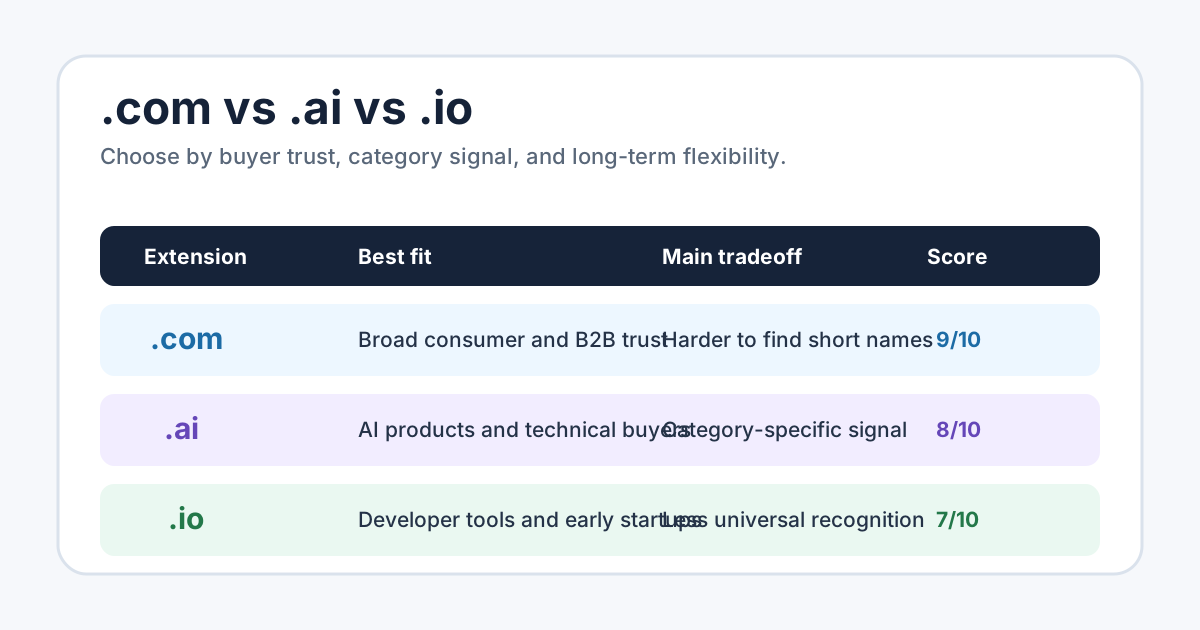 A quick comparison of the most common startup domain extension choices.
For many startups, the domain decision comes down to three options: pay more for a .com, use a category-signaling .ai, or choose a startup-friendly .io. There is no universal winner. The right extension depends on your audience, price point, category, and how much friction the domain creates.
The domain extension should support trust. It should not need a long explanation every time someone hears your company name.
The Short Version
Choose .com when you can get a clean, affordable version of the name and your audience is broad. It is still the default extension many buyers assume.
Choose .ai when artificial intelligence is central to the product and your buyers understand the category. It can make the positioning clearer, especially for AI-native tools.
Choose .io when you are selling to technical buyers, developer teams, or early adopters who already accept startup-style domains.
If the extension makes the name harder to remember, keep looking. A short, clear non-.com often beats a long, awkward .com.
When .com Is the Best Choice
.com is the safest extension for broad trust. It works across consumer, B2B, local, enterprise, and international audiences. If someone hears your brand in a conversation, .com is often the first domain they try.
Use .com when:
- The buyer is not especially technical.
- The brand needs to feel established.
- You sell to enterprise, finance, healthcare, or mainstream consumers.
- You can get a short, clean domain without a strange spelling.
- You plan to expand beyond one narrow category.
The downside is availability. Many short .com names are taken, expensive, or parked by investors. Do not damage a strong brand by forcing it into a clumsy .com with extra words, hyphens, or confusing abbreviations.
When .ai Is the Best Choice
.ai has become a strong category signal for artificial intelligence products. If AI is not just a feature but the core of the company, .ai can help customers understand the product faster.
Use .ai when:
- AI is central to the promise.
- Your buyers are familiar with AI tools.
- The
.aidomain is much cleaner than the available.com. - The name sounds complete with
.ai. - You want the domain itself to reinforce the category.
The tradeoff is specificity. If the company later expands beyond AI or wants a more timeless brand, the extension may feel narrower. That does not make it wrong, but it is worth considering before you commit.
When .io Is the Best Choice
.io has long been common among developer tools, infrastructure startups, crypto projects, and technical products. It can still work well when the audience is comfortable with startup naming patterns.
Use .io when:
- You sell to developers or technical teams.
- The name is short and strong.
- The
.comis unavailable or overpriced. - The product has a modern software feel.
- Your audience will not be confused by the extension.
The downside is broader recognition. Outside technical circles, some buyers may not remember .io as easily as .com. If your product sells to operations teams, consumers, or offline businesses, test the domain aloud before choosing it.
Compare the Whole Domain, Not Just the Extension
A domain is a full phrase, not a suffix. Compare these factors:
- Length: Is the full domain easy to type?
- Sound: Does it pass the radio test?
- Visual clarity: Are there ambiguous letters or numbers?
- Trust: Will the buyer recognize the extension?
- Future fit: Will the domain still work after the product expands?
- Cost: Is the registration or acquisition price reasonable?
For example, lumin.ai may be stronger than getluminplatform.com because it is shorter and easier to say. But lumin.com would likely be stronger than both if it were available and affordable.
What About Other Extensions?
Other extensions can work when they match the use case. A mobile product might use .app, a nonprofit might use .org, a local brand might use a country code, and a community project might use .co or .club.
The same rule applies: if your audience understands it and the full domain is clean, it can work. If the extension creates confusion, avoid it.
You can review official top-level domain information through IANA's Root Zone Database and registration data through ICANN Lookup.
Frequently Asked Questions
Is .com still better for SEO?
The extension itself is not a magic ranking factor. The bigger SEO issue is user trust, click behavior, backlinks, and brand recognition. A clean domain that people trust is better than an awkward domain chosen only for the extension.
Is .ai only for artificial intelligence companies?
Practically, yes. You can use it elsewhere, but most users now read .ai as an AI signal. If that signal does not fit your product, it may create confusion.
Should I buy the .com later?
If the .com is strategically important and affordable, yes. Many startups launch on another extension and acquire the .com later. Just do not build a brand that depends on a domain you may never be able to buy.
Is .io still credible for startups?
Yes, especially for technical audiences. For mainstream or non-technical buyers, test it before committing.
Next Step
Run your shortlist through DomainRapids, then use How Long Should a Domain Name Be? to compare full-domain readability, not just the extension.